When it comes to operating system design, there are two main approaches: microkernel and monolithic kernel. Both have their pros and cons, and in this article, we will explore the main differences between them.
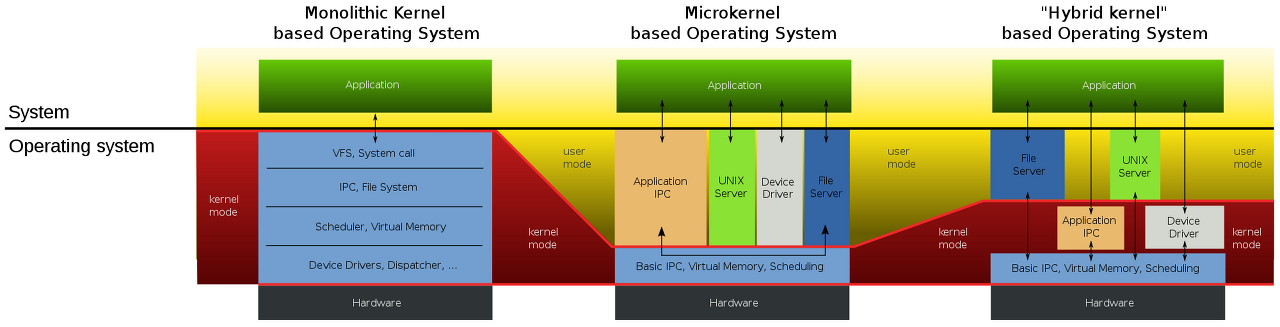
Monolithic Kernel
A monolithic kernel is an operating system architecture where the entire operating system runs in kernel space. This means that all the basic system services such as process scheduling, memory management, and device drivers are part of the kernel. The monolithic kernel provides a single address space, which means that all the code and data are in the same place, and it is easier to share information between different parts of the kernel. The monolithic kernels use signals and sockets to communicate between inter-processes.
- Advantages of the Monolithic Kernel:
- High performance
- Efficient communication between kernel modules
- Disadvantages of the Monolithic Kernel:
- Difficult to maintain and upgrade due to interdependencies in the code
- Security, Reliability
Microkernel
A microkernel is an operating system architecture where the kernel is stripped down to its most basic functions, and other services are provided by separate processes, called servers. The microkernel provides a minimal set of services, such as inter-process communication and basic memory management. All other services, such as device drivers and file systems, run as separate processes in user space. Communication Microkernels use the messaging queues to achieve IPC.
- Advantages of the Microkernel:
- Easier to maintain and extend
- More secure, and reliable (because less code is running in kernel mode)
- Disadvantages of the Microkernel:
- Lower performance (because of overhead due to communication between user space and kernel space)
- More complex implementation
Hybrid Systems
Most modern operating systems are actually not one pure model, but hybrid systems.
Plus, many modern operating systems implement loadable kernel modules, so each core component is separate and each is loadable as needed within the kernel.
- Linux kernels are monolithic by having the OS in a single kernel address space, but also modular for dynamic loading of functionality
Conclusion
In conclusion, the choice between a monolithic kernel and a microkernel depends on the requirements of the system. A monolithic kernel is generally faster and simpler to implement, but a microkernel is modular and easier to maintain. Both have their advantages and disadvantages, and it is up to the operating system designer to decide which architecture is best suited for their system.
'SW' 카테고리의 다른 글
| SW 엔지니어를 위한 GPU 관련 내용 간단 정리?가 아니라 일단 정리 (NVIDIA GPU 기준) (0) | 2026.06.30 |
|---|---|
| Socket.IO의 Namespace, Event, Room 개념 헷갈려서 정리해봤습니다 (0) | 2026.06.25 |
| 백엔드 프레임워크를 선택하기 전에 알아야 할 동시성 모델 레츠고 (0) | 2026.06.24 |